This Tool Has Saved Me Over $500 on Flights This Year — and It Stacks With Points
Is now the right time to buy my flight?
The price has been steadily going down. Maybe I'll wait a few more days until it drops further.
And then — it jumps.
This is an all-too-common occurrence. Timing when to buy a flight is like timing the market: it's a losing game.
For the past year, I've been using a tool that's saved me over $500 on airfare. The best part? It stacks with all the other cost-saving strategies I already use — points, credit cards and airfare deals.
Here's what you need to know.
Ever since the major U.S. airlines eliminated change fees during COVID — and have since made the policy permanent — a new era of flexibility emerged.
Pre-pandemic, airlines would charge $100 or more to change or cancel flights.
Those days are behind us.
United was the first domino to fall, eliminating change and cancellation fees for most reservations in an effort to entice more people to fly. Delta followed shortly after, and American begrudgingly came along about three months later.
Then came Alaska and JetBlue.
Since airlines still offer Basic Economy fares with change fees attached, think of buying a Main Cabin ticket almost as insurance — you're pre-paying for flexibility.
Yes, Main is more expensive than Basic Economy.
But in almost all cases, I tell my friends to book Main or higher to ensure they have maximum flexibility. And that's what makes Autopilot possible.
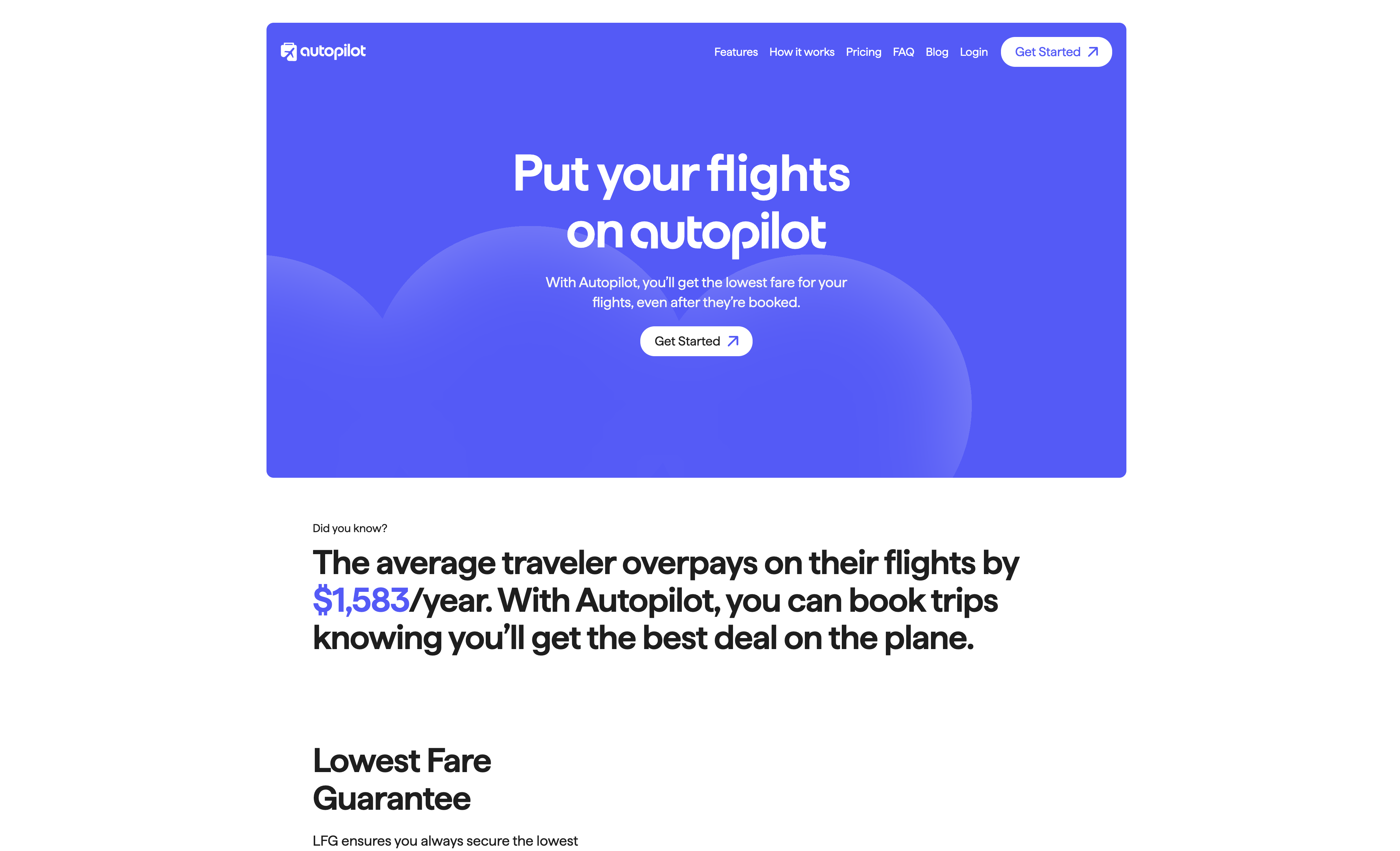
Autopilot is a post-booking travel platform that gets you money back if the price of your flight drops after you've already booked.
In essence, they price-match airfare you've already purchased when the airline lowers the fare.
Here's an example: You buy a flight today for $500. Three days later, the airline drops the price of the exact same flight to $400. Autopilot works with the airline to price-match to the lower fare, getting you $100 back.

They do this without changing your confirmation number, itinerary or seat assignments.
If you purchased a refundable fare — or a non-refundable fare within the last 24 hours — Autopilot will get you money back to your original form of payment.
Otherwise, you'll receive a travel credit, which you typically have about a year to use.
The best part? Autopilot's business model is pay-only-when-you-save.
If they don't save you money, you don't pay them anything. They simply charge 25% of whatever they save you.
Autopilot's flagship feature is called Lowest Fare Guarantee — or LFG for short.
The concept is simple: They monitor your booked flights in real time. If the price drops, they reprice your ticket and get you money back.
Set it and forget it.
Here's something many travelers don't realize: When the major U.S. airlines eliminated change fees during COVID, they quietly unlocked a powerful money-saving strategy.
If you book a Main Cabin fare or higher on American, Delta or United, you can now change or cancel that ticket for free.
The catch? You have to actually monitor the price. And then go through the process of rebooking, or spend hours contacting the airline's customer support to reprice the reservation.
Most people don't bother.
Autopilot's smart fare engine continuously compares your exact booking details against real-time airline pricing.
When a qualifying lower fare appears — at least $20 less than what you paid — their ticketing team handles the rest.
They work directly with the airline to reprice your ticket.
Your confirmation number stays the same. Your seat assignments don't change. Your itinerary remains identical.
The only thing that changes is the price (and sometimes the fare class - the letter code associated with your ticket, which only effects a small number of elite travelers).
For refundable tickets, Autopilot secures a refund to your original form of payment. For non-refundable tickets, they get you an airline credit deposited directly into your account.
If the price drops multiple times? Even better. Autopilot generates a new credit each time the fare falls by $20 or more.
Currently, Lowest Fare Guarantee works with flights booked directly on:
All cabins are supported except Basic Economy — which makes sense, since Basic Economy tickets have a fee to be changed or canceled anyway.
Flights booked through online travel agencies like Expedia or Kayak aren't supported. You need to book direct with the airline.
Manually tracking flight prices is tedious.
You'd have to check Google Flights every day, set up price alerts, then go through the rebooking process yourself — which often means contacting the airline or navigating confusing online change flows.
Autopilot takes care of it all.
You forward your confirmation email (or link your Gmail), and they handle the rest. No monitoring. No phone calls. No hassle.
Autopilot offers a Pro tier — an optional upgrade to the pay-as-you-go model — and it's well worth it in my opinion.
One of the best Pro features is called Upgrades on Autopilot.
If you're a frequent flyer, you know that complimentary upgrades for elite status are unfortunately on their way out. Airlines are increasingly favoring personalized upgrade offers instead.
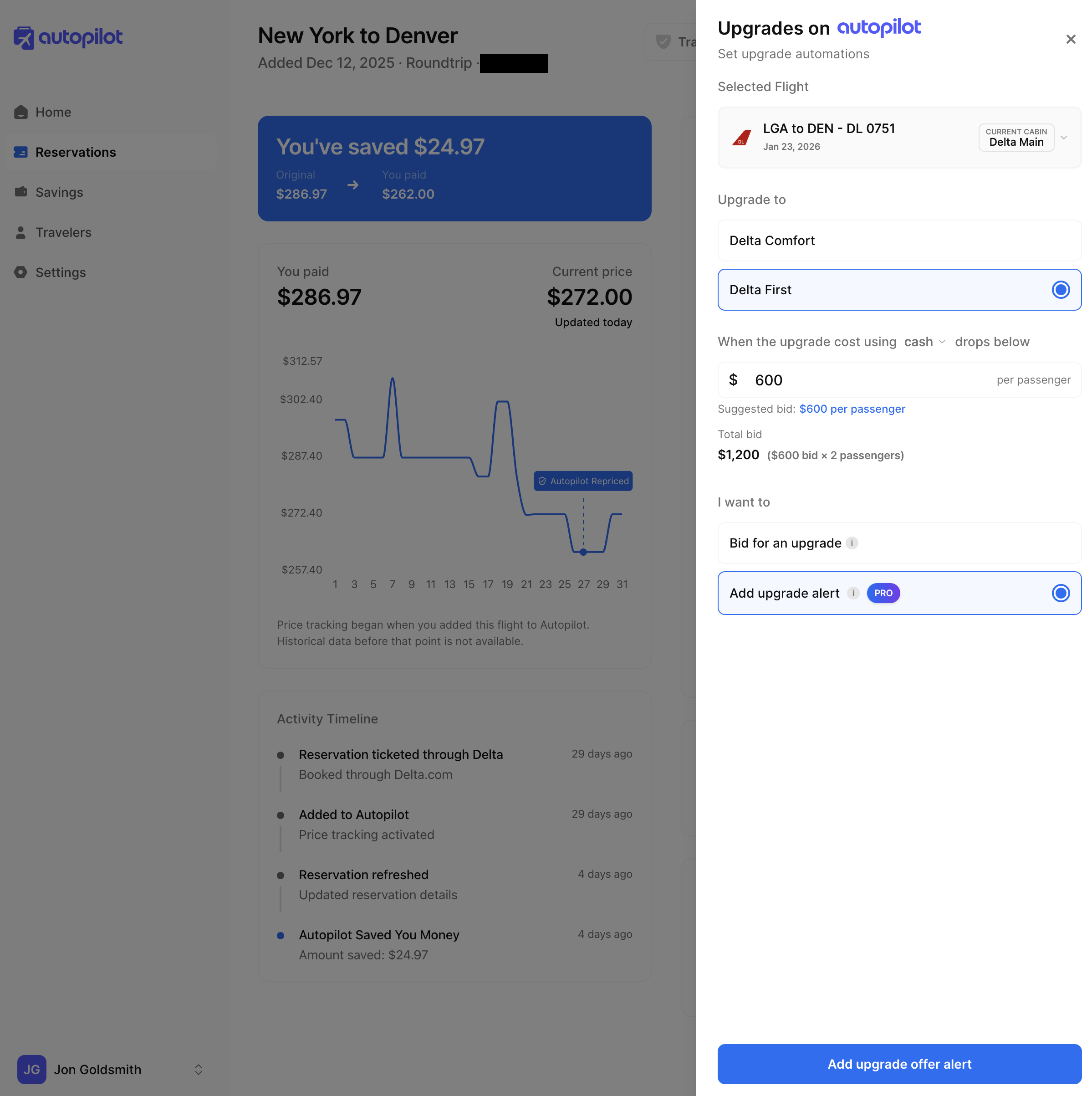
Autopilot lets you set upgrade offer alerts. They'll monitor the price to upgrade from your current cabin to your desired one, and if the price drops below your threshold, they'll send you an email.

They're also rolling out a feature called Bid for an Upgrade.
Here's how it works: You set a maximum price you're willing to pay. If Autopilot finds an upgrade at the airline's price plus their 25% fee — and it's still under your threshold — they'll secure it automatically.
If the upgrade plus fee would exceed your limit, they'll lower or waive their fee entirely to make sure you get the upgrade.
You don't need Pro to use this feature.
Autopilot tracks award flights booked with airline points and miles.
You do need to be on their Pro plan to use this feature, though there's no additional fee when they find you savings — just the standard Pro subscription.
As long as the award price drops by 1,000 or more, you'll get an alert from Autopilot that the points price dropped!
This has saved me 38,000 points just this year (which wasn't factored into my grand total at all, but could be worth another $500 worth of travel).
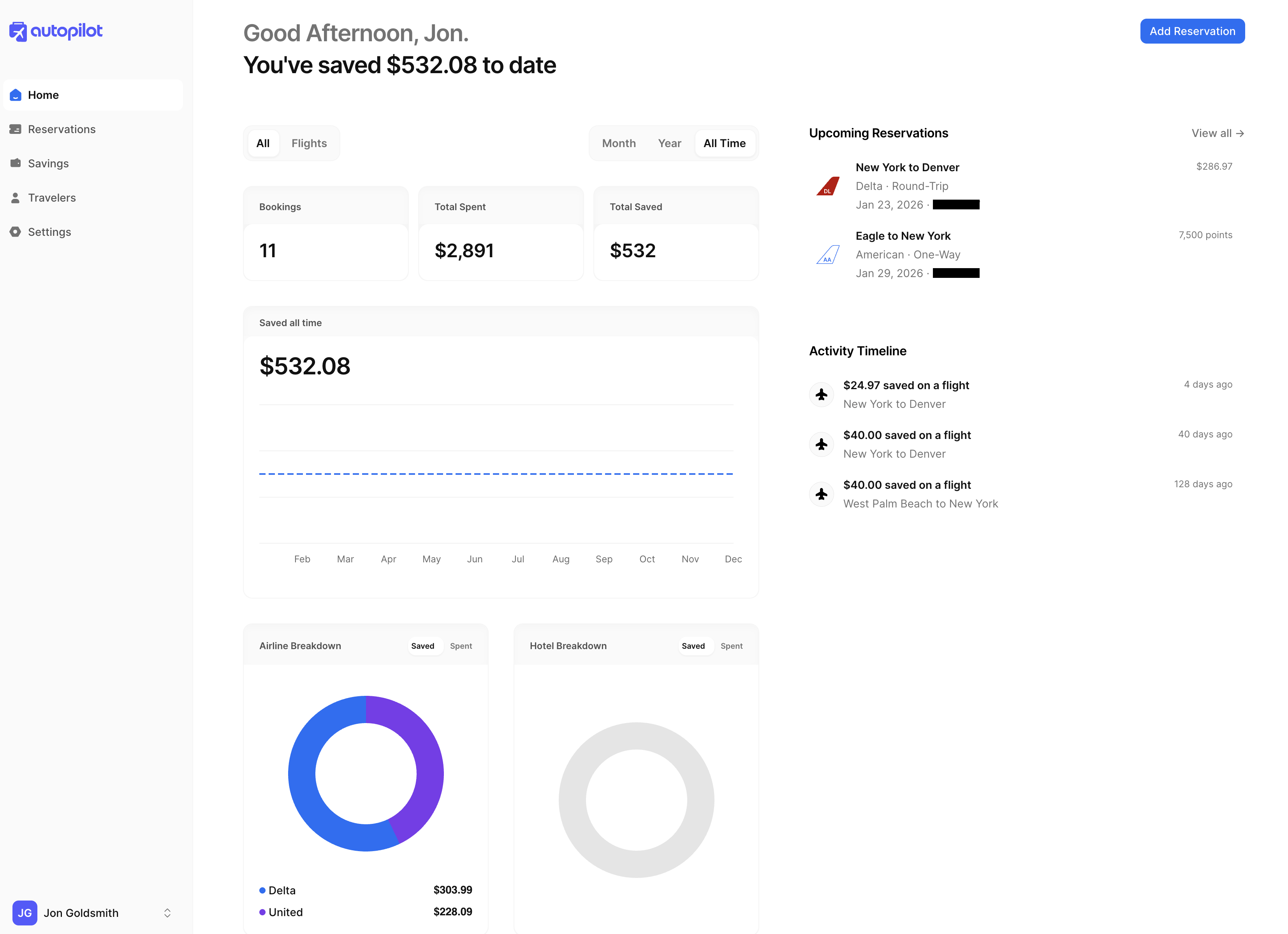
I'm a big points and miles traveler. I don't frequently pay out of pocket for flights.
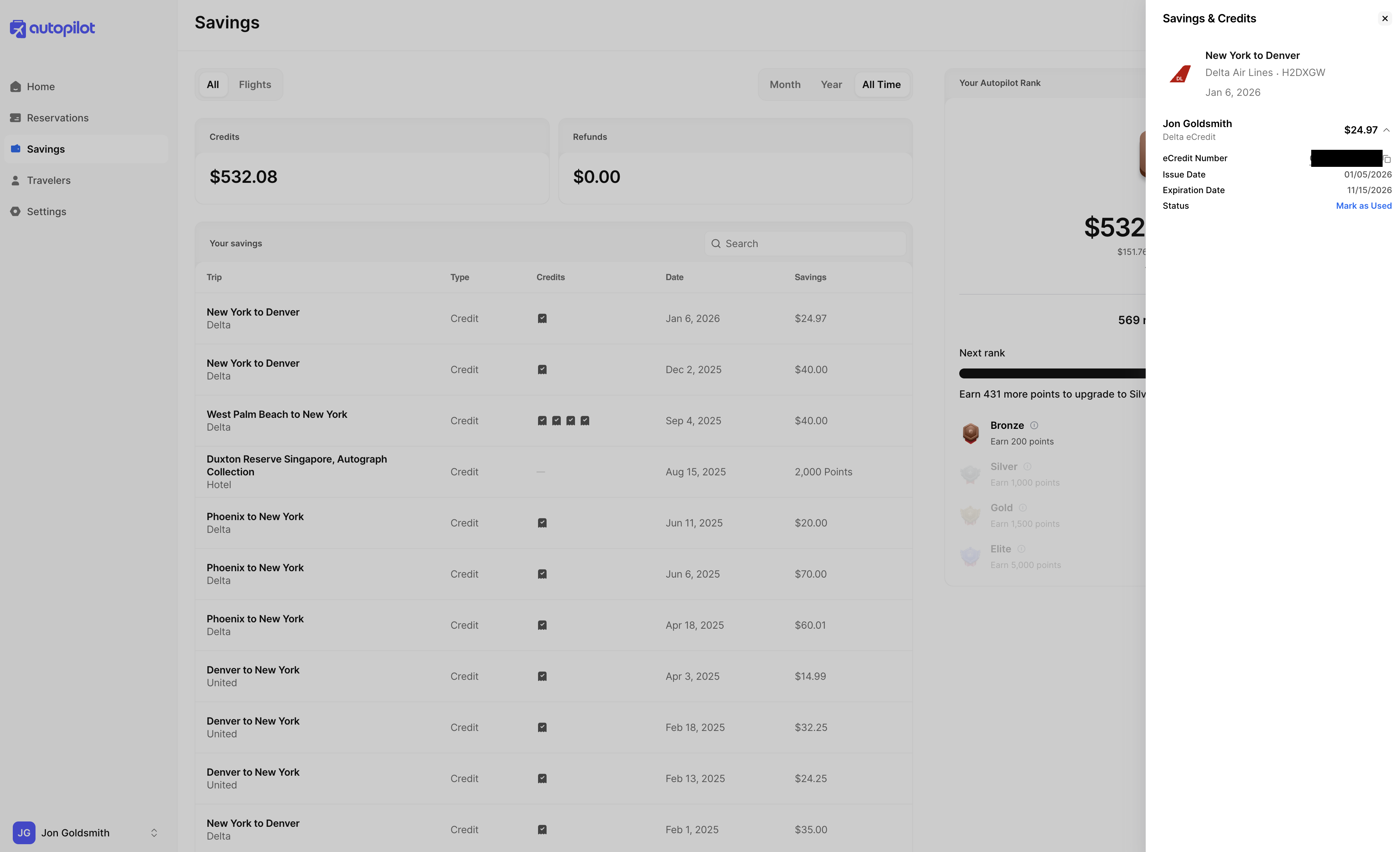
But looking back at 2025, for the flights I did pay cash for, Autopilot got me back over $532.
Considering I spent no more than $2,891 on flights this year, that's almost 20% back (18% to be exact) — just for adding my flights into Autopilot.
The best part? The service only cost me around $125 in fees.
Autopilot only supports flights booked directly with American Airlines, Alaska Airlines, Delta Air Lines and United Airlines.
That covers most of my flying. But I have plenty of friends on other carriers who'd love to use the service.
It also doesn't support reservations booked through online travel agencies. I don't use OTAs, but many travelers do.
And I'd love to see this expand to hotels.
I already do the same price tracking manually for hotel bookings — monitoring rates and canceling and rebooking when prices drop. Having Autopilot automate that process would be a game-changer.
If you're paying cash for flights on the major U.S. carriers, Autopilot is a no-brainer.
The pay-only-when-you-save model means there's zero risk.
I've saved over $500 this year alone — and I'll continue adding every flight I book.
Share article


Is now the right time to buy my flight?
The price has been steadily going down. Maybe I'll wait a few more days until it drops further.
And then — it jumps.
This is an all-too-common occurrence. Timing when to buy a flight is like timing the market: it's a losing game.
For the past year, I've been using a tool that's saved me over $500 on airfare. The best part? It stacks with all the other cost-saving strategies I already use — points, credit cards and airfare deals.
Here's what you need to know.
Ever since the major U.S. airlines eliminated change fees during COVID — and have since made the policy permanent — a new era of flexibility emerged.
Pre-pandemic, airlines would charge $100 or more to change or cancel flights.
Those days are behind us.
United was the first domino to fall, eliminating change and cancellation fees for most reservations in an effort to entice more people to fly. Delta followed shortly after, and American begrudgingly came along about three months later.
Then came Alaska and JetBlue.
Since airlines still offer Basic Economy fares with change fees attached, think of buying a Main Cabin ticket almost as insurance — you're pre-paying for flexibility.
Yes, Main is more expensive than Basic Economy.
But in almost all cases, I tell my friends to book Main or higher to ensure they have maximum flexibility. And that's what makes Autopilot possible.
Autopilot is a post-booking travel platform that gets you money back if the price of your flight drops after you've already booked.
In essence, they price-match airfare you've already purchased when the airline lowers the fare.
Here's an example: You buy a flight today for $500. Three days later, the airline drops the price of the exact same flight to $400. Autopilot works with the airline to price-match to the lower fare, getting you $100 back.
They do this without changing your confirmation number, itinerary or seat assignments.
If you purchased a refundable fare — or a non-refundable fare within the last 24 hours — Autopilot will get you money back to your original form of payment.
Otherwise, you'll receive a travel credit, which you typically have about a year to use.
The best part? Autopilot's business model is pay-only-when-you-save.
If they don't save you money, you don't pay them anything. They simply charge 25% of whatever they save you.
Autopilot's flagship feature is called Lowest Fare Guarantee — or LFG for short.
The concept is simple: They monitor your booked flights in real time. If the price drops, they reprice your ticket and get you money back.
Set it and forget it.
Here's something many travelers don't realize: When the major U.S. airlines eliminated change fees during COVID, they quietly unlocked a powerful money-saving strategy.
If you book a Main Cabin fare or higher on American, Delta or United, you can now change or cancel that ticket for free.
The catch? You have to actually monitor the price. And then go through the process of rebooking, or spend hours contacting the airline's customer support to reprice the reservation.
Most people don't bother.
Autopilot's smart fare engine continuously compares your exact booking details against real-time airline pricing.
When a qualifying lower fare appears — at least $20 less than what you paid — their ticketing team handles the rest.
They work directly with the airline to reprice your ticket.
Your confirmation number stays the same. Your seat assignments don't change. Your itinerary remains identical.
The only thing that changes is the price (and sometimes the fare class - the letter code associated with your ticket, which only effects a small number of elite travelers).
For refundable tickets, Autopilot secures a refund to your original form of payment. For non-refundable tickets, they get you an airline credit deposited directly into your account.
If the price drops multiple times? Even better. Autopilot generates a new credit each time the fare falls by $20 or more.
Currently, Lowest Fare Guarantee works with flights booked directly on:
All cabins are supported except Basic Economy — which makes sense, since Basic Economy tickets have a fee to be changed or canceled anyway.
Flights booked through online travel agencies like Expedia or Kayak aren't supported. You need to book direct with the airline.
Manually tracking flight prices is tedious.
You'd have to check Google Flights every day, set up price alerts, then go through the rebooking process yourself — which often means contacting the airline or navigating confusing online change flows.
Autopilot takes care of it all.
You forward your confirmation email (or link your Gmail), and they handle the rest. No monitoring. No phone calls. No hassle.
Autopilot offers a Pro tier — an optional upgrade to the pay-as-you-go model — and it's well worth it in my opinion.
One of the best Pro features is called Upgrades on Autopilot.
If you're a frequent flyer, you know that complimentary upgrades for elite status are unfortunately on their way out. Airlines are increasingly favoring personalized upgrade offers instead.
Autopilot lets you set upgrade offer alerts. They'll monitor the price to upgrade from your current cabin to your desired one, and if the price drops below your threshold, they'll send you an email.
They're also rolling out a feature called Bid for an Upgrade.
Here's how it works: You set a maximum price you're willing to pay. If Autopilot finds an upgrade at the airline's price plus their 25% fee — and it's still under your threshold — they'll secure it automatically.
If the upgrade plus fee would exceed your limit, they'll lower or waive their fee entirely to make sure you get the upgrade.
You don't need Pro to use this feature.
Autopilot tracks award flights booked with airline points and miles.
You do need to be on their Pro plan to use this feature, though there's no additional fee when they find you savings — just the standard Pro subscription.
As long as the award price drops by 1,000 or more, you'll get an alert from Autopilot that the points price dropped!
This has saved me 38,000 points just this year (which wasn't factored into my grand total at all, but could be worth another $500 worth of travel).
I'm a big points and miles traveler. I don't frequently pay out of pocket for flights.
But looking back at 2025, for the flights I did pay cash for, Autopilot got me back over $532.
Considering I spent no more than $2,891 on flights this year, that's almost 20% back (18% to be exact) — just for adding my flights into Autopilot.
The best part? The service only cost me around $125 in fees.
Autopilot only supports flights booked directly with American Airlines, Alaska Airlines, Delta Air Lines and United Airlines.
That covers most of my flying. But I have plenty of friends on other carriers who'd love to use the service.
It also doesn't support reservations booked through online travel agencies. I don't use OTAs, but many travelers do.
And I'd love to see this expand to hotels.
I already do the same price tracking manually for hotel bookings — monitoring rates and canceling and rebooking when prices drop. Having Autopilot automate that process would be a game-changer.
If you're paying cash for flights on the major U.S. carriers, Autopilot is a no-brainer.
The pay-only-when-you-save model means there's zero risk.
I've saved over $500 this year alone — and I'll continue adding every flight I book.